Though women were leading a growing movement of more independence and economic independence, sexual discrimination had not disappeared, and men typically still handled key positions in finance and marketing within the businesses. In addition, they faced competetion and reluctance from druggists who preferred to shelve products from prestigous male perfumers and needed more convincing and a high demand to sell products made by women, especially African Americans. In response, female beauty culturists developed new ways of distribution, sales, and marketing lik:e mail order, door to door peddling operations, specific hair or skin care programs at beauty schools (some entrepreneurs had franchise operations with these schools), and pyramid organization (multilevel marketing that trained women in a specific beauty method who in turn taught more recruiters, widening the distribution circle). These companies promoted charismatic capitalism, institutions that incorporated a profit organization with characteristics of social reform.

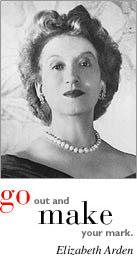
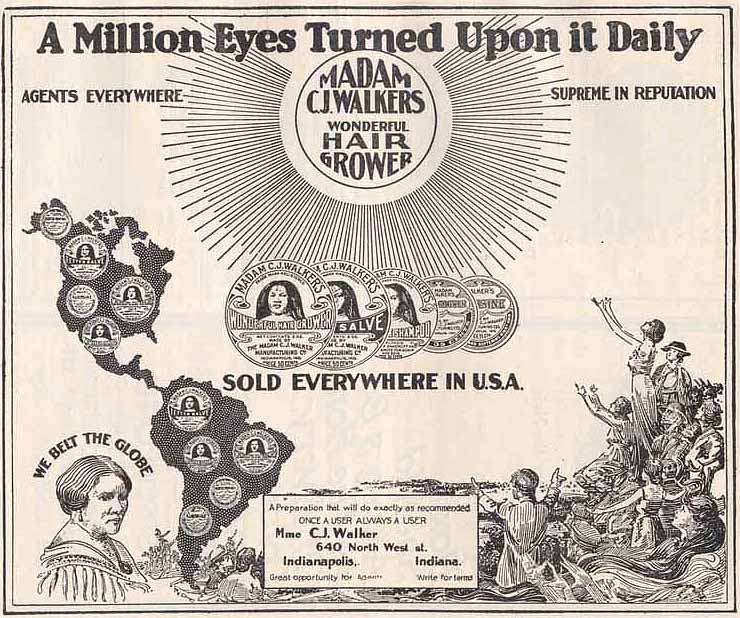
Those involved in the beauty business faced a dilemma on how to create a better face for the cosmetics industry when it was so widely viewed as sinful and shameful not so long ago. Men in the beauty trade usually utilized patent dramatic before and after advertisements or sold their miscellaneous cosmetology products rather matter of factly. On the other hand, women tended to use their experiences and personalities to appeal to their consumers more effectively, such as Elizabeth Arden and her "pink" femininity. They often reshaped their images to main active in the industry, like how Helena Rubinstein had an inclusive view, adopting all sorts of girls into her business and supporting the equal rights movement and how Madame C. J. Walker often used her background as a hard worker on the cotton fields to relate with many other African Americans.
The way expertise and personality
was portrayed through white businesswoman was the key to their success.
Although they did not utilize many advertisements as women magazines often
banned ads that seemed far fetched and never lent ad space to African American
companies, the practice of going door to door and mail order achieved
substantial achievement by establishing personal bonds and relationships with
clients. In addition, this rising trust led to beauty parlors and salons to
become a social meeting place for urban middle and upper class women and eased
the embarrassment and ignorance for women discreetly attempting to use
cosmetics. Public lectures and demonstrations, like Madame Yale’s “The Religion
of Beauty, the Sin of Ugliness”, followed suit and created wide consumerism to
a diverse public, advertising to rural and immigrant ladies and promoting that
beautification had become necessary rather than shameful. This indicated the
shift from paints to make up
(enhancing one’s features instead of covering or painting over it) as more
women, especially the bourgeois, began to include this ritual in their daily
routines. Beauty culturists incorporated this into the feminist movement and
ascertained that beauty “was more powerful than the ballot” (pg 87). Soon,
prominent figures in cosmetics, like Elizabeth Arden and Helena Rubinstein,
began to transform elitist beauty culture into a modern industry by selling
costly cosmetics to high line stores but appealing to all women who had money
to spend, urging them to join the high society by purchasing their products.

The commercial
beauty culture for African American remained segregated among whites,
especially with the promotion of skin bleachers for white consumers. Some black
beauty culturists encouraged the emulation of the white society and asserted
that paler skin and straight hair would create more opportunities and social
freedom. However, the most significant businesses, like Madame C. J. Walker and
Malone, encouraged beauty among the African American community as a method of
personal dignity and communal support with succumbing to white standards. Hair
grooming brought these ladies together as they advertised orally and through agents
in the pyramid organization, spreading rapidly with the lure of a secure job
with fair salaries and conditions for black, disabled, or ill women. Walker and
Malone also advocated religious principles into their work, along with black
women’s rights movements to gain support and justify their institutions. This
represented the ideal of the business
family group, promoting trade while building up the community.
Questions:
How did the beauty industry transform women's place in society?
What kind of ways did businesswoman use to support the rising cosmetics market?

This is truly a great read for me. I have bookmarked it and I am looking forward to reading new articles. Keep up the good work!.
ReplyDeleteקוסמטיקאית